
Australian Standards for Slip Resistance
Understanding AS 4586 slip ratings and how to specify compliant flooring for Australian commercial environments.

Slip ratings explained
Different areas require different slip rating requirements, as outlined by the National Construction Code (NCC) and the HB 197:1999 & HB 198:2014 – Table 3B guides to slip resistance of pedestrian surfaces, which are guides only.
The SA HB 198:2014 Handbook - Table 3B provides valuable insights into the specification and testing of slip resistance for pedestrian surfaces. It details slip rating requirements using methods such as the 'wet pendulum', 'oil-wet inclined ramp', and 'wet barefoot' tests, catering to various environments.
AS 4586:2013 Slip resistance classifications
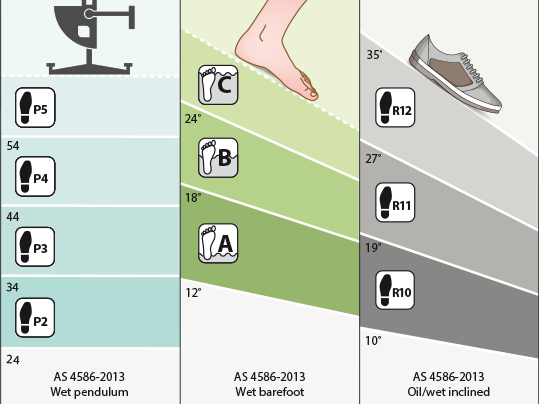
The Australian standards AS 4586:2013, Slip resistance classifications of new pedestrian surface materials consists of the following:
Wet pendulum slip resistance test (P rating) – The preferred test method for on-site testing utilises a pendulum friction tester to determine the slip resistance of the floor. 
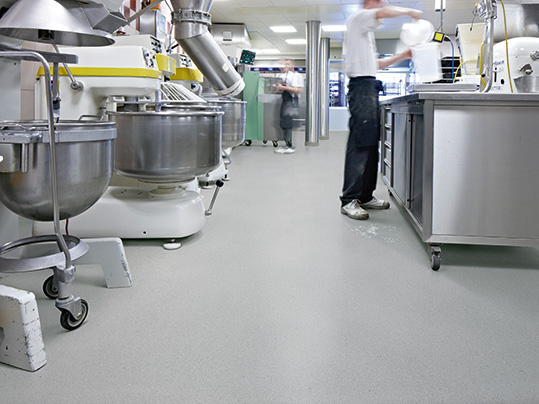
Oil/wet inclined ramp slip resistance test (R rating) – Oil simulates contamination other than water often found in for example commercial kitchens.
Wet barefoot inclined ramp slip resistance test – Used for wet area product testing, for products such as Safestep Aqua, Surestep Star barefoot and Surestep Laguna.
True safety floor
For a floor covering to be deemed a true safety or slip-resistant floor, by definition, it must contain slip-resistant particles; this is according to the standard EN 13845 – sustainable slip resistance.
Visual guide to Australian standards for slip resistance
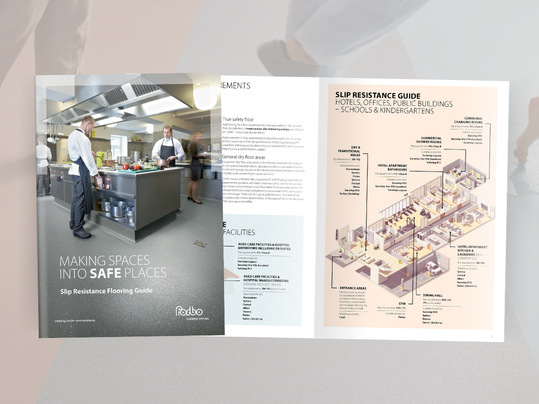
Standards documents bury slip requirements in dense tables. We’ve turned them into one visual guide, so you can see the slip rating guidelines for each area at a glance.
What you'll get
- Slip rating guidelines by area, mapped visually
- Recommended Forbo options matched to each rating
- P and R ratings explained
Get the visual slip rating guide ➜
Forbo Step safety flooring range
Forbo has over 50 years of experience in designing and manufacturing safety vinyl floor coverings.
Our Step safety flooring collection is a complete range of products that meet safety requirements across a wide variety of applications.
They are ideal not only in general spaces but also in more extreme areas, such as wetroom (barefoot) areas, commercial kitchens and industrial applications.
View Step safety flooring
Step slip rating classifications
| Step ranges | Wet pendulum* | Oil/wet ramp, barefoot |
| Safestep R11 | P4 | R11 |
| Safestep R12 | P5 | R12 |
| Safestep Aqua | P4 | R10, C |
| Surestep Laguna | P4 | R10, B |
| Surestep Original, Stone, Wood, Balance | P4 | R10 |
* Pendulum values of Forbo safety vinyl have been achieved in an accredited 3rd party laboratory. Forbo will not be liable or responsible for highly variable and varying in situ results.
Frequently asked questions
Q: What is slip resistance?
Slip resistance measures how safely a floor surface performs underfoot, particularly in wet or contaminated conditions. In Australia, slip resistance is assessed under AS 4586 testing methods, which classify flooring based on performance in dry, wet or greasy environments.
Q: What is AS 4586?
AS 4586 is the Australian Standard for assessing the slip resistance of floor surfaces. It defines classification systems such as P ratings (pendulum test) and R ratings (ramp test), helping specifiers determine appropriate flooring for specific applications.
Q: What is the difference between R rating and P rating?
R ratings are determined using ramp testing under oil-contaminated conditions, while P ratings use pendulum testing in wet conditions. Specifications may reference either, depending on project requirements and application type.
Q: What slip rating is required for Commercial Kitchens?
Commercial kitchens in Australia typically require R12 high slip resistance suitable for wet and greasy conditions. Flooring must comply with AS 4586 and meet classifications appropriate for high-risk areas exposed to oil and water.

Find a Supplier
Get pricing lead times or chat with our team.
Find a supplier near you ➜

Order Samples
Order up to five free samples.
Order free samples ➜